
Moving to Poland as a Foreigner: Your Complete Guide to PESEL, Zameldowanie and Karta Pobytu
Starting a new life in Poland is exciting — a new job, new opportunities and a fresh chapter abroad. But behind that fresh start there is a layer of official paperwork that every foreigner has to deal with sooner or later. PESEL, Zameldowanie, Karta Pobytu, NIP, ZUS — the names alone can feel overwhelming, especially when the forms are in Polish and each office has its own rules and queues.
The good news: once you understand what each step is for and the order it usually happens in, the whole process becomes far less intimidating. This guide walks you through the key official procedures for living and working in Poland, in plain language for newcomers.
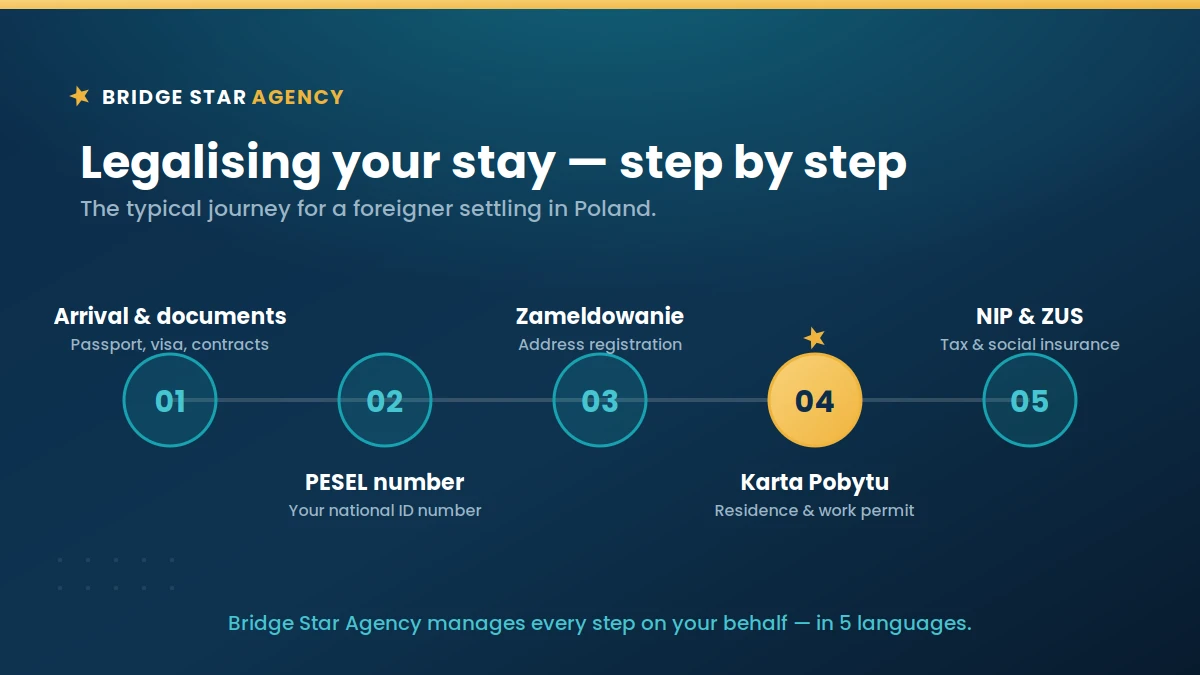
Your roadmap at a glance. Most foreigners settle in through a similar sequence: arrival and documents (passport, visa, contracts), then the PESEL number, then Zameldowanie (address registration), then Karta Pobytu (residence card), and finally NIP and ZUS if you work or run a business. You won't always do them in this exact order, and not everyone needs every step — but this is the backbone of "becoming official" in Poland.
The PESEL number — your key to almost everything. PESEL is Poland's universal personal identification number. Think of it as the number that connects you to the Polish administrative system. You'll be asked for it constantly: at the doctor, in tax matters, when signing certain contracts, registering a child for school or using government services online. It is handled at the municipal office — Urząd Miasta or Urząd Gminy — usually the one responsible for where you live. What matters most is a valid ID document, a legal basis for the number, and a correctly completed application with the right attachments. Small form errors or a missing document are the most common reasons applications get delayed.
Zameldowanie — registering where you live. This is the registration of your place of residence, either for a temporary stay (pobyt czasowy) or a permanent one (pobyt stały). Registering your address links you to a specific place in official records and is frequently requested in other procedures. It is also handled at the local Urząd Miasta / Gminy, and usually requires documents proving you have the right to live at the address — which often means cooperation from the property owner. This is where many newcomers get stuck, because the paperwork has to line up between tenant and owner.
Karta Pobytu — your residence card. The residence card is one of the most important documents for a foreigner in Poland. It is issued after a residence permit is granted and confirms your legal right to stay — and, depending on the type, often your right to work. The most common routes are a temporary residence permit (zezwolenie na pobyt czasowy) and a work permit (zezwolenie na pracę). These applications usually go through the Voivodeship Office (Urząd Wojewódzki) and tend to be the most document-heavy and time-sensitive part of the journey. Deadlines, renewals and tracking your case all matter — missing an extension window can create real complications.
NIP and ZUS — tax and social insurance. Once you are working or running a business, two more institutions appear. NIP (Numer Identyfikacji Podatkowej) is your tax identification number, used in tax and business matters. ZUS (Zakład Ubezpieczeń Społecznych) is Poland's social insurance institution, covering social and health contributions. For employees, much of this is arranged through the employer; for entrepreneurs it becomes a more active responsibility. Registering correctly from the start saves a lot of trouble later.
Five mistakes that slow foreigners down. Doing steps in the wrong order, when some depend on others being done first; submitting incomplete documents, where one missing attachment means another appointment; translation and form errors, because Polish forms are easy to misread; missing deadlines, especially for permit extensions; and going it alone with no Polish, which adds stress and risk. None of these is dramatic on its own, but together they can turn a few weeks into a few months.
Why work with Bridge Star Agency. Official procedures in Poland are manageable — but they reward people who know the system, the paperwork and the right order of steps. We bring real experience working with foreigners across the full range of procedures, services aligned with Polish legislation, fast and transparent handling so you always know where your case stands, and support in five languages: Azerbaijani, Turkish, English, Russian and Polish. We act as the bridge between you and the Polish administrative system, so you can focus on your job, your family and your new life while we handle the forms, the offices and the deadlines.
Ready to make your stay official? Tell us where you are in the journey and we'll take it from there — in your language. 📩 contact@bridgestarconsulting.pl · bridgestarconsulting.pl